
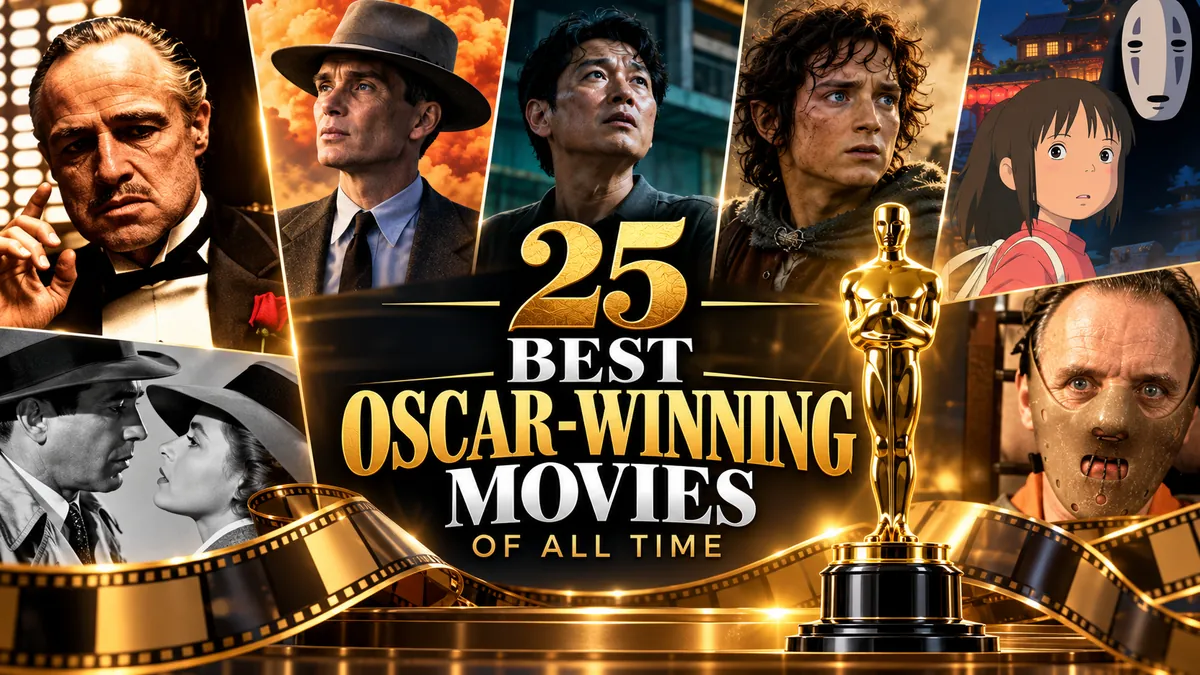
25 Best Oscar-Winning Movies of All Time (2026)
Winning an Academy Award does not automatically make a movie great.
Some Oscar winners have aged beautifully. Others feel inseparable from the year in which they won. And many of cinema’s most influential films never won Best Picture at all.
That is why our ranking of the best Oscar winning movies goes beyond simply listing Best Picture winners.
To qualify, a film must have won at least one competitive Academy Award. From there, we considered critical reputation, filmmaking achievement, cultural influence, audience appeal, performances, rewatchability and how strongly each movie continues to resonate with viewers today.
The result stretches from Casablanca and The Godfather to The Lord of the Rings: The Return of the King, Parasite, Oppenheimer and the latest Best Picture winner, One Battle after Another.
Whether you are building a classic-film watchlist or simply looking for an exceptional movie tonight, these are our picks for the 25 best Oscar-winning movies of all time.
Best Oscar-Winning Movies: Quick Ranking
| Rank | Movie | Year | Major Oscar Achievement | Best For |
|---|---|---|---|---|
| 1 | The Godfather | 1972 | Best Picture | Crime drama |
| 2 | The Lord of the Rings: The Return of the King | 2003 | 11 wins including Best Picture | Epic fantasy |
| 3 | Schindler’s List | 1993 | 7 wins including Best Picture | Historical drama |
| 4 | Casablanca | 1942 | 3 wins including Best Picture | Classic romance |
| 5 | The Godfather Part II | 1974 | 6 wins including Best Picture | Crime epic |
| 6 | Parasite | 2019 | 4 wins including Best Picture | Thriller/social satire |
| 7 | One Flew Over the Cuckoo’s Nest | 1975 | The “Big Five” Oscars | Character drama |
| 8 | The Silence of the Lambs | 1991 | The “Big Five” Oscars | Psychological thriller |
| 9 | Lawrence of Arabia | 1962 | 7 wins including Best Picture | Historical epic |
| 10 | No Country for Old Men | 2007 | 4 wins including Best Picture | Neo-Western thriller |
| 11 | 2001: A Space Odyssey | 1968 | Best Visual Effects | Science fiction |
| 12 | Amadeus | 1984 | 8 wins including Best Picture | Music/period drama |
| 13 | The Departed | 2006 | 4 wins including Best Picture | Crime thriller |
| 14 | Oppenheimer | 2023 | 7 wins including Best Picture | Historical biopic |
| 15 | The Apartment | 1960 | 5 wins including Best Picture | Comedy-drama |
| 16 | Spirited Away | 2001 | Best Animated Feature | Animation/fantasy |
| 17 | The Deer Hunter | 1978 | 5 wins including Best Picture | War drama |
| 18 | Everything Everywhere All at Once | 2022 | 7 wins including Best Picture | Multiverse comedy-drama |
| 19 | The French Connection | 1971 | 5 wins including Best Picture | Crime/action |
| 20 | Gladiator | 2000 | 5 wins including Best Picture | Historical action |
| 21 | Moonlight | 2016 | 3 wins including Best Picture | Coming-of-age drama |
| 22 | One Battle after Another | 2025 | 6 wins including Best Picture | Political action-drama |
| 23 | The Exorcist | 1973 | 2 Academy Awards | Horror |
| 24 | Get Out | 2017 | Best Original Screenplay | Horror/social satire |
| 25 | Mad Max: Fury Road | 2015 | 6 Academy Awards | Action |
1. The Godfather
Year: 1972
Director: Francis Ford Coppola
Oscar wins: 3
Major win: Best Picture
Few movies have influenced popular culture as deeply as The Godfather.
Francis Ford Coppola transformed Mario Puzo’s crime novel into something much larger than a gangster movie: a tragedy about family, loyalty, power and the compromises people make while convincing themselves they are protecting those they love.
Marlon Brando’s Don Vito Corleone became one of cinema’s defining characters, but Al Pacino’s transformation as Michael gives the film its emotional architecture.
The Academy awarded The Godfather Best Picture, Best Actor for Brando and Adapted Screenplay.
More than five decades later, it remains extraordinarily watchable.
Why it ranks No. 1: It combines artistic greatness, cultural influence, unforgettable performances and mainstream storytelling better than almost any Oscar winner.
Watch it if you like: Crime sagas, family dramas and character-driven storytelling.
2. The Lord of the Rings: The Return of the King
Year: 2003
Director: Peter Jackson
Oscar wins: 11
Major win: Best Picture
Fantasy had rarely received Hollywood’s highest institutional recognition before Peter Jackson completed his Middle-earth trilogy.
The Return of the King changed that.
The movie won all 11 Academy Awards for which it was nominated, tying the record for the most Oscars won by a single film.
But statistics alone do not explain its position here.
The film works because years of character development, sacrifice and world-building converge into an enormous emotional payoff.
Its battles remain spectacular, yet the quieter moments involving friendship, courage and the cost of victory give the spectacle meaning.
Why it ranks this high: It proved blockbuster fantasy could deliver technical ambition, emotional storytelling and awards-level filmmaking simultaneously.
Viewing advice: Watch The Fellowship of the Ring and The Two Towers first. This is a finale, not a standalone introduction.
3. Schindler’s List
Year: 1993
Director: Steven Spielberg
Oscar wins: 7
Major win: Best Picture
Schindler’s List is not casual viewing.
Nor should it be.
Steven Spielberg’s Holocaust drama follows German industrialist Oskar Schindler and the Jewish workers whose lives became connected to his factories during World War II.
Shot predominantly in black and white, the film strips away much of the visual comfort associated with conventional historical epics.
Liam Neeson, Ben Kingsley and Ralph Fiennes lead a film that remains devastating precisely because Spielberg generally resists turning its historical horror into spectacle.
It won seven Academy Awards, including Best Picture and Spielberg’s first Oscar for directing.
Why it matters: Few Best Picture winners carry the same historical, emotional and cinematic weight.
Watch it if: You are prepared for an intense historical drama rather than entertainment in the conventional sense.
4. Casablanca
Year: 1942
Director: Michael Curtiz
Oscar wins: 3
Major win: Best Picture
Some classics require viewers to adjust to an older filmmaking language.
Casablanca barely does.
Humphrey Bogart and Ingrid Bergman’s wartime romance remains witty, romantic, melancholy and remarkably accessible.
Set around Rick’s Café Américain in Vichy-controlled Casablanca during World War II, the movie blends romance with political urgency without allowing either element to overwhelm the other.
It won Best Picture, Director and Screenplay at the Academy Awards.
Its dialogue and imagery became cultural shorthand, but Casablanca survives beyond its famous moments because the underlying emotional conflict still works.
Why it ranks No. 4: Few films from Hollywood’s classical era remain this immediately enjoyable.
Best for: Anyone who thinks old movies are difficult to watch.
5. The Godfather Part II
Year: 1974
Director: Francis Ford Coppola
Oscar wins: 6
Major win: Best Picture
Sequels were not supposed to surpass Oscar-winning masterpieces.
Then came The Godfather Part II.
Coppola expands the Corleone story in two directions, contrasting Michael Corleone’s increasingly isolated leadership with the earlier life of his father, Vito.
Robert De Niro won Supporting Actor for playing the younger Vito, while the film itself became the first sequel to win Best Picture.
Its structure is more demanding than the original, and its mood is colder.
That is precisely the point.
Why it deserves its place: It does not repeat The Godfather. It interrogates it.
Watch it if: You want one of cinema’s richest examinations of power and moral decay.
6. Parasite
Year: 2019
Director: Bong Joon Ho
Oscar wins: 4
Major win: Best Picture
Parasite made Academy Awards history.
Bong Joon Ho’s South Korean film became the first non-English-language movie to win Best Picture.
It also won Director, Original Screenplay and International Feature Film.
Those milestones matter, but focusing exclusively on them undersells the movie itself.
Parasite moves effortlessly between black comedy, family drama, thriller and social satire. Its examination of class inequality is accessible without becoming simplistic.
The less you know about the plot before watching, the better.
Why it ranks No. 6: It combines arthouse intelligence with the momentum of a mainstream thriller.
Watch it if: You want a film that constantly changes shape without losing control.
7. One Flew Over the Cuckoo’s Nest
Year: 1975
Director: Miloš Forman
Oscar wins: 5
Major achievement: Won the “Big Five”
Jack Nicholson delivers one of his defining performances as Randle McMurphy, whose arrival at a psychiatric institution puts him into conflict with Nurse Ratched, played by Louise Fletcher.
The film became only the second movie in Academy history to win all five major categories:
Best Picture;
Director;
Actor;
Actress;
and Screenplay.
The movie’s treatment of mental-health institutions belongs to its era and invites modern discussion, but its central conflict over individuality, authority and dignity remains powerful.
Why it belongs here: Nicholson and Fletcher create one of cinema’s great screen confrontations.
8. The Silence of the Lambs
Year: 1991
Director: Jonathan Demme
Oscar wins: 5
Major achievement: Won the “Big Five”
A horror-inflected psychological thriller winning Best Picture remains unusual.
The Silence of the Lambs did much more.
It became the third movie to sweep the Academy’s five major awards: Picture, Director, Actor, Actress and Screenplay.
Jodie Foster anchors the film as FBI trainee Clarice Starling, while Anthony Hopkins turns limited screen time into one of cinema’s most famous performances as Hannibal Lecter.
What keeps the film effective is not gore.
It is control.
Jonathan Demme uses framing, conversation and uncomfortable proximity to build tension.
Why it ranks so highly: It remains one of the finest intersections of prestige filmmaking and genre entertainment.
9. Lawrence of Arabia
Year: 1962
Director: David Lean
Oscar wins: 7
Major win: Best Picture
If you want to understand why cinema screens became enormous, watch Lawrence of Arabia on the largest screen available.
David Lean’s historical epic turns desert landscapes into visual storytelling.
Peter O’Toole stars as T.E. Lawrence in a film interested not simply in military adventure but in identity, ego, mythology and the contradictions involved in turning real people into legends.
The film won seven Oscars, including Best Picture and Director.
Some of its cultural representation reflects the period in which it was made and deserves critical scrutiny today.
Its visual influence, however, is undeniable.
Best for: Viewers who want filmmaking on a monumental scale.
10. No Country for Old Men
Year: 2007
Directors: Joel and Ethan Coen
Oscar wins: 4
Major win: Best Picture
The Coen brothers took Cormac McCarthy’s novel and created one of the 21st century’s most unsettling American thrillers.
Javier Bardem’s Anton Chigurh became instantly iconic, but No Country for Old Men is much more than a memorable villain.
The film examines violence, chance, aging and a world whose moral logic seems to be slipping beyond the understanding of those living in it.
It won four Oscars, including Best Picture, Director and Supporting Actor for Bardem.
Why it makes the top 10: Almost every filmmaking choice feels deliberate, yet the movie never feels mechanically constructed.
11. 2001: A Space Odyssey
Year: 1968
Director: Stanley Kubrick
Oscar wins: 1
Major win: Best Visual Effects
No, 2001: A Space Odyssey did not win Best Picture.
It only won one competitive Academy Award: Visual Effects.
Yet leaving it off a list of the greatest Oscar-winning movies would be absurd.
Stanley Kubrick’s science-fiction landmark changed how filmmakers imagined space, technology and cinematic scale.
HAL 9000 became a cultural icon. The visual effects remain astonishing. Its deliberate pacing continues to divide newcomers.
This is not science fiction built around exposition.
Kubrick expects viewers to observe, interpret and occasionally remain uncertain.
Why it ranks No. 11: Its influence on science-fiction cinema is almost impossible to overstate.
Watch it if: You enjoy visually ambitious films that leave room for interpretation.
12. Amadeus
Year: 1984
Director: Miloš Forman
Oscar wins: 8
Major win: Best Picture
You do not need to care about classical music to love Amadeus.
That is one of its greatest accomplishments.
The film dramatizes the rivalry between Antonio Salieri and Wolfgang Amadeus Mozart, treating genius as both miraculous and infuriating.
F. Murray Abraham won Best Actor for Salieri, and the film collected eight Oscars overall.
Historical liberties are part of its dramatic construction, so it should not be mistaken for a documentary account.
As cinema, however, it is electrifying.
Why it belongs here: Few films have made artistic jealousy this entertaining.
13. The Departed
Year: 2006
Director: Martin Scorsese
Oscar wins: 4
Major win: Best Picture
It is remarkable that Martin Scorsese waited until The Departed to win his first directing Oscar.
His Boston crime thriller is one of his most accessible films.
Leonardo DiCaprio and Matt Damon play men operating on opposite sides of an infiltration game involving police and organized crime, while Jack Nicholson supplies unpredictable menace.
The film moves quickly despite its substantial running time.
It is violent, funny, tense and relentlessly watchable.
Why it ranks here: It combines Scorsese’s filmmaking mastery with the propulsion of a crowd-pleasing thriller.
14. Oppenheimer
Year: 2023
Director: Christopher Nolan
Oscar wins: 7
Major win: Best Picture
Christopher Nolan turned a three-hour historical drama about theoretical physics, political power and moral responsibility into a global theatrical event.
That alone would make Oppenheimer significant.
Its Academy Awards performance confirmed the scale of the achievement.
The film won seven Oscars, including Best Picture, Director, Actor for Cillian Murphy and Supporting Actor for Robert Downey Jr.
Nolan constructs the story through overlapping timelines, subjective imagery and dense conversation rather than conventional biopic simplicity.
Why it already belongs among the classics: It demonstrates that serious adult historical filmmaking can still become mass-market cinema.
Best for: Viewers who like intellectually dense dramas with blockbuster filmmaking.
15. The Apartment
Year: 1960
Director: Billy Wilder
Oscar wins: 5
Major win: Best Picture
Billy Wilder’s The Apartment starts with a premise that sounds like a cynical workplace comedy.
Then it becomes something much more humane.
Jack Lemmon plays an office worker attempting to advance his career by allowing executives to use his apartment for affairs. Shirley MacLaine plays an elevator operator whose life becomes intertwined with his.
The movie won five Oscars, including Best Picture and Director.
Its workplace politics have changed with time.
Its loneliness has not.
Why it deserves rediscovery: It is funny without being shallow and romantic without becoming sentimental.
16. Spirited Away
Year: 2001
Director: Hayao Miyazaki
Oscar win: Best Animated Feature
Hayao Miyazaki’s Spirited Away won Best Animated Feature and became one of the defining animated films of the century.
The story follows young Chihiro into a strange spirit world filled with transformations, mysterious creatures and unforgettable visual ideas.
Children can experience it as an adventure.
Adults can find ideas about identity, greed, work, environmental change and growing up.
That layered accessibility is central to Miyazaki’s genius.
Why it ranks here: Animation is cinema, and few films demonstrate that more convincingly.
Best for: Families, animation fans and viewers discovering Studio Ghibli.
17. The Deer Hunter
Year: 1978
Director: Michael Cimino
Oscar wins: 5
Major win: Best Picture
The Deer Hunter is long, emotionally punishing and deliberately structured.
It is also one of the defining American films about the psychological consequences of war.
Robert De Niro, Christopher Walken and Meryl Streep lead an ensemble whose relationships before, during and after the Vietnam War give the film its emotional force.
Walken won Supporting Actor, while the film won Best Picture and Director.
Its representation of Vietnam has generated significant criticism and debate.
That context should accompany modern viewing.
Why it remains important: Few war films are as focused on what happens to people after combat enters their lives.
18. Everything Everywhere All at Once
Year: 2022
Directors: Daniel Kwan and Daniel Scheinert
Oscar wins: 7
Major win: Best Picture
A multiverse movie involving martial arts, family conflict, absurdist comedy and existential anxiety hardly sounds like traditional Academy material.
That was part of the excitement.
Everything Everywhere All at Once won seven Oscars, including Best Picture, Director and Actress for Michelle Yeoh.
Ke Huy Quan and Jamie Lee Curtis also won supporting acting awards.
Beneath its maximalist editing and deliberately ridiculous ideas is a surprisingly simple emotional question:
How do people remain connected when life becomes overwhelming?
Why it matters: It represents an Academy increasingly willing to recognize formally adventurous genre filmmaking.
19. The French Connection
Year: 1971
Director: William Friedkin
Oscar wins: 5
Major win: Best Picture
Modern crime movies owe a significant debt to The French Connection.
William Friedkin brings documentary-like grit to the story of New York detectives pursuing a narcotics operation.
Gene Hackman won Best Actor as Jimmy “Popeye” Doyle.
The movie also won Picture and Director.
Its famous chase remains thrilling, but the film’s real influence lies in its texture: dirty streets, imperfect people and procedural tension.
Why it deserves its position: It helped redefine how gritty mainstream crime cinema could look and move.
20. Gladiator
Year: 2000
Director: Ridley Scott
Oscar wins: 5
Major win: Best Picture
Gladiator helped revive the Hollywood historical epic for a new generation.
Russell Crowe won Best Actor as Maximus, a Roman general forced into gladiatorial combat after political betrayal.
Ridley Scott delivers enormous spectacle, but the movie’s enduring appeal comes from its emotional simplicity.
Revenge.
Honor.
Loss.
Loyalty.
Those themes make the action matter.
The film won five Oscars, including Best Picture.
Why it remains highly rewatchable: It is prestige filmmaking built with the momentum of a blockbuster.
21. Moonlight
Year: 2016
Director: Barry Jenkins
Oscar wins: 3
Major win: Best Picture
The chaotic announcement of Moonlight‘s Best Picture victory initially threatened to overshadow the achievement.
Time has corrected that.
Barry Jenkins’ film follows its central character through three stages of life, examining identity, masculinity, intimacy and the lasting effects of childhood.
Mahershala Ali won Supporting Actor, and the film also won Adapted Screenplay.
Its filmmaking is intimate without feeling small.
Color, music and silence carry as much emotional meaning as dialogue.
Why it belongs here: Moonlight is one of the most emotionally precise Best Picture winners of the modern era.
22. One Battle after Another
Year: 2025
Director: Paul Thomas Anderson
Oscar wins: 6
Major win: Best Picture
The newest film on our list has already secured a remarkable place in Academy history.
At the 98th Academy Awards, held March 15, 2026, Paul Thomas Anderson’s One Battle after Another won Best Picture.
Anderson also won Oscars for directing and adapted screenplay, while Sean Penn won Supporting Actor. The film additionally won Film Editing and Casting, giving it six awards overall.
Its inclusion this high comes with an obvious caveat: unlike Casablanca or The Godfather, it has not had decades to prove its staying power.
But contemporary relevance matters too.
The film combines political anxiety, action, dark humor and family drama in the unmistakably ambitious style associated with Anderson.
Why it makes the list: It is the current Best Picture winner and one of the defining award-season films of the mid-2020s.
Long-term question: Whether it eventually climbs higher will depend on how strongly audiences and filmmakers continue returning to it.
23. The Exorcist
Year: 1973
Director: William Friedkin
Oscar wins: 2
Major win: Best Adapted Screenplay
Horror historically struggles at the Oscars.
The Exorcist forced the Academy to take the genre seriously.
It became the first horror film nominated for Best Picture and ultimately won two Oscars: Adapted Screenplay and Sound.
Decades of imitators have borrowed its imagery, structure and approach to possession.
Few have reproduced its unsettling atmosphere.
William Friedkin treats the supernatural material with a procedural seriousness that makes the extraordinary events feel disturbingly plausible within the film’s world.
Why it belongs here: Its impact extends far beyond horror.
24. Get Out
Year: 2017
Director: Jordan Peele
Oscar win: Best Original Screenplay
Jordan Peele’s directorial debut arrived as a horror movie and quickly became a cultural event.
Daniel Kaluuya plays Chris, whose visit to his girlfriend’s family home becomes increasingly unsettling.
Saying much more would reduce the experience for first-time viewers.
Peele uses genre conventions to explore race, social performance and supposedly progressive spaces while maintaining the structure of an entertaining thriller.
He won the Academy Award for Original Screenplay.
Why it deserves its place: Get Out is one of the clearest examples of modern horror operating simultaneously as entertainment and social commentary.
25. Mad Max: Fury Road
Year: 2015
Director: George Miller
Oscar wins: 6
Mad Max: Fury Road did not win Best Picture.
It did, however, win six Academy Awards—the most of any film at the 88th Oscars.
Those wins reflected the extraordinary craft behind George Miller’s action masterpiece.
Editing.
Production design.
Costumes.
Makeup.
Sound.
Every technical department contributes to momentum.
Charlize Theron’s Furiosa became the emotional center of a film that communicates enormous amounts of story visually.
Why it closes the ranking: Very few action movies have demonstrated this level of filmmaking precision.
Best for: Anyone who thinks awards movies have to be slow.
Best Oscar-Winning Movies by Genre
Different viewers want different kinds of Oscar movies.
Best Crime Movies
Start with:
The Godfather
The Godfather Part II
The Departed
No Country for Old Men
The French Connection
For a first-time viewer, The Godfather remains the obvious starting point.
Best Oscar-Winning Historical Movies
Our picks are:
Schindler’s List
Lawrence of Arabia
Oppenheimer
Amadeus
Gladiator
Remember that dramatic films frequently compress events, combine characters or take historical liberties.
Use them as cinema—not as substitutes for historical scholarship.
Best Oscar-Winning Horror Movies
Oscar recognition for horror remains relatively rare.
Start with:
The Silence of the Lambs
The Exorcist
Get Out
Each demonstrates a different side of the genre: psychological terror, supernatural horror and social satire.
Best Oscar-Winning Movies for Action Fans
Try:
The Lord of the Rings: The Return of the King
Gladiator
Mad Max: Fury Road
The French Connection
These movies demonstrate that technical filmmaking and visceral entertainment are not opposites.
Best Oscar-Winning Movies for Beginners
If you rarely watch older or awards-focused films, do not start with the most demanding movie on the list.
Try this five-film introduction:
- The Godfather
- Parasite
- The Lord of the Rings: The Return of the King
- Oppenheimer
- Gladiator
They combine critical prestige with strong mainstream entertainment value.
Best Oscar-Winning Movies From the 21st Century
Our strongest modern recommendations include:
The Lord of the Rings: The Return of the King
Parasite
No Country for Old Men
The Departed
Oppenheimer
Everything Everywhere All at Once
Moonlight
One Battle after Another
Get Out
Mad Max: Fury Road
The variety itself tells an interesting story about how the Academy has evolved.
Fantasy, horror, international cinema, multiverse comedy and unconventional independent drama now occupy awards conversations that were once dominated more heavily by traditional prestige productions.
Best Picture Winner vs Oscar-Winning Movie: What’s the Difference?
These terms are not interchangeable.
A Best Picture winner won the Academy Award for Best Picture.
An Oscar-winning movie won at least one Academy Award in any competitive category.
That is why films such as:
2001: A Space Odyssey;
Spirited Away;
The Exorcist;
Get Out;
and Mad Max: Fury Road
qualify for this ranking even though they did not win Best Picture.
Restricting the list only to Best Picture winners would exclude too many extraordinary films.
Which Movies Have Won the Most Oscars?
Three films share the record with 11 Academy Awards:
Ben-Hur
Titanic
The Lord of the Rings: The Return of the King
The Return of the King is especially remarkable because it won all 11 categories in which it was nominated.
Oscar totals are interesting, but they are not our primary ranking criterion.
A film winning fewer awards can ultimately become more influential than a film that dominated one particular ceremony.
What Are the “Big Five” Oscars?
The Academy’s so-called “Big Five” are:
Best Picture;
Best Director;
Best Actor;
Best Actress;
and a screenplay award.
Only three films have won all five:
It Happened One Night
One Flew Over the Cuckoo’s Nest
The Silence of the Lambs
Two of those appear in our top 10.
Do Oscar-Winning Movies Always Age Well?
No.
Awards reflect a specific moment.
Voters respond to the films, industry, politics, campaigns and cultural environment of their time.
Public opinion can evolve dramatically.
Some winners become more admired.
Others decline in reputation.
Meanwhile, movies that lost major awards can become canonical classics.
That is one reason a ranking like this should consider long-term influence alongside trophies.
An Oscar records what the Academy recognized.
History decides what audiences continue watching.
What Makes an Oscar-Winning Movie Truly Great?
Winning an award is an achievement.
Becoming a classic requires more.
Performances That Survive Their Era
Brando in The Godfather.
Hopkins and Foster in The Silence of the Lambs.
Nicholson and Fletcher in One Flew Over the Cuckoo’s Nest.
Great performances remain compelling even when acting styles change.
Filmmaking That Influences Other Filmmakers
You can trace decades of cinema through films such as:
2001: A Space Odyssey;
The Godfather;
The French Connection;
and Mad Max: Fury Road.
Influence matters.
Emotional Durability
Technical innovation eventually becomes technically ordinary.
Emotion lasts longer.
Casablanca remains beloved because its central choices still hurt.
Rewatchability
Not every masterpiece needs to be rewatched annually.
But great movies reveal additional detail on repeat viewing.
Cultural Relevance
The greatest films often remain useful ways of discussing their themes decades later.
That does not mean they must express modern values perfectly.
It means they still provoke thought.
How We Ranked the Best Oscar-Winning Movies
This is an editorial ranking rather than a mathematical score.
We considered six major factors.
1. Critical Reputation
How strongly is the film regarded by critics, filmmakers and film culture?
2. Audience Appeal
Does it connect beyond specialist cinephile circles?
3. Influence
Did the movie change filmmaking, inspire later work or redefine its genre?
4. Rewatchability
Does the film continue rewarding viewers?
5. Filmmaking Achievement
We considered writing, directing, acting, cinematography, editing, sound, design and overall execution.
6. Longevity and Relevance
Has the movie endured?
For recent films such as Oppenheimer and One Battle after Another, long-term judgment is necessarily less certain, so their placement also reflects contemporary impact.
Oscar count itself was not a scoring system.
If it were, the list would look very different.
Frequently Asked Questions
What are the best Oscar-winning movies of all time?
Our top five are:
- The Godfather
- The Lord of the Rings: The Return of the King
- Schindler’s List
- Casablanca
- The Godfather Part II
The ranking balances critical reputation, cultural influence, filmmaking quality, audience appeal and longevity.
What is the best Oscar-winning movie to watch first?
Start with The Godfather if you want a universally acclaimed classic.
For something newer, choose Parasite or Oppenheimer.
For action and spectacle, choose Gladiator.
What movie won Best Picture at the 2026 Oscars?
One Battle after Another won Best Picture at the 98th Academy Awards on March 15, 2026.
Paul Thomas Anderson also won Director and Adapted Screenplay for the film.
Which movie has won the most Oscars?
Three movies share the record with 11 wins:
Ben-Hur, Titanic and The Lord of the Rings: The Return of the King.
Did The Godfather win Best Picture?
Yes.
The Godfather won Best Picture at the 45th Academy Awards.
It also won Best Actor for Marlon Brando and Adapted Screenplay.
Did The Godfather Part II win Best Picture?
Yes.
The Godfather Part II won six Oscars, including Best Picture.
It became the first sequel to win the Academy’s top prize.
Did 2001: A Space Odyssey win an Oscar?
Yes.
Stanley Kubrick won the film’s Academy Award for Visual Effects.
Despite its enormous subsequent influence, the film did not win Best Picture.
Did Spirited Away win an Oscar?
Yes.
Hayao Miyazaki’s Spirited Away won Best Animated Feature at the 75th Academy Awards.
Which horror movies have won Oscars?
Many horror and horror-adjacent films have received Academy recognition.
Notable examples include The Exorcist, The Silence of the Lambs and Get Out.
The Silence of the Lambs also won Best Picture.
What was the first non-English-language movie to win Best Picture?
Bong Joon Ho’s Parasite became the first non-English-language film to win Best Picture.
It won four Academy Awards overall.
Which films won all five major Oscars?
Three movies have achieved the “Big Five” sweep:
It Happened One Night;
One Flew Over the Cuckoo’s Nest;
and The Silence of the Lambs.
Is Oppenheimer worth watching?
Yes.
Oppenheimer is one of the strongest recent Best Picture winners, particularly for viewers who enjoy historical dramas, nonlinear storytelling and Christopher Nolan’s filmmaking style.
It won seven Academy Awards.
Are Best Picture winners always the best movies of their year?
No.
The Academy Awards represent the choices of Academy voters during a particular awards season.
Film criticism and audience opinion continue evolving afterward.
Many movies that lost Best Picture—or were never nominated—are now considered masterpieces.
Where can I watch Oscar-winning movies?
Streaming availability varies significantly by country and changes as licensing agreements expire.
Check the movie on your preferred streaming service or a reputable regional streaming-search service before subscribing or renting specifically to watch it.
Final Verdict
If you watch only one film from this ranking, make it The Godfather.
More than 50 years after its release, Francis Ford Coppola’s crime epic remains an extraordinary combination of acting, writing, cinematography, music, atmosphere and narrative control.
But the Academy’s history is far larger than Best Picture.
2001: A Space Odyssey demonstrates the power of visual imagination.
Spirited Away proves animation belongs beside live-action masterpieces.
The Exorcist and Get Out show how horror can penetrate awards culture.
Parasite changed what a Best Picture winner could look and sound like.
Oppenheimer demonstrated the continuing commercial power of ambitious historical filmmaking.
And One Battle after Another, the 2026 Best Picture winner, represents the latest chapter in a story the Academy has been writing for nearly a century.
The Oscars are imperfect.
Their choices will always inspire arguments.
But when you look across the greatest films the Academy has honored, you also get something remarkable:
a century-spanning map of how cinema evolved.
And that makes the best Oscar winning movies an excellent place to begin exploring film history.


