
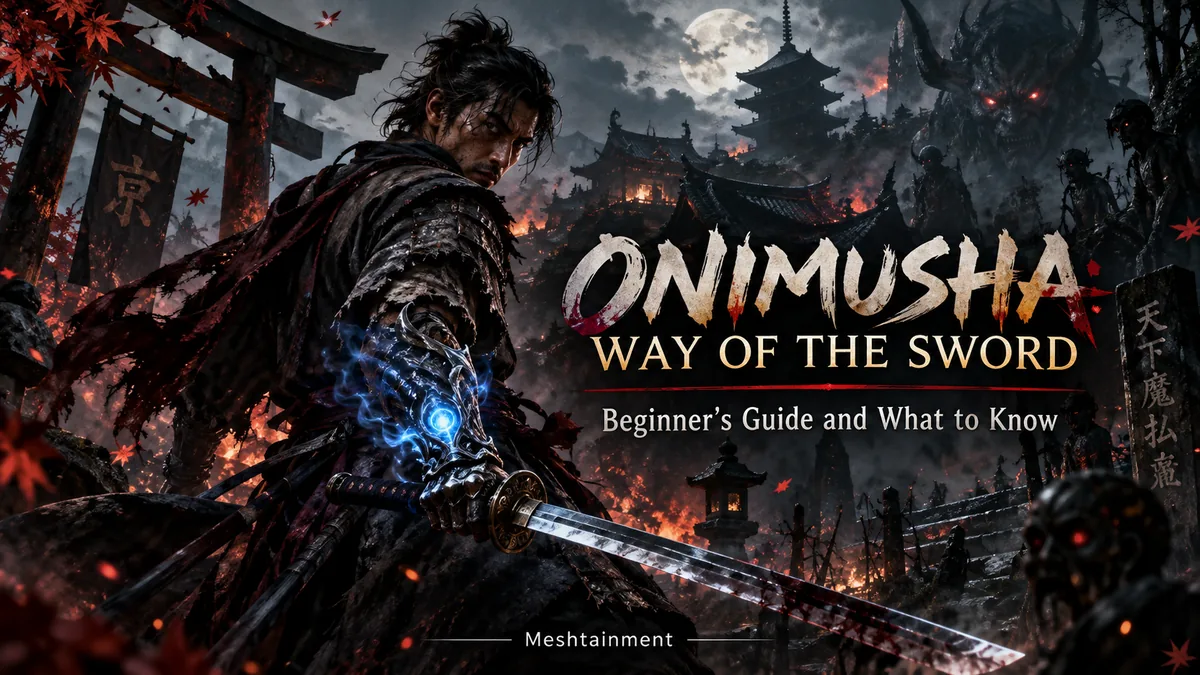
Onimusha Way of the Sword Guide: Beginner Tips
Onimusha: Way of the Sword has officially brought Capcom’s samurai action series back into the spotlight, combining supernatural Japanese horror with deliberate sword combat, aggressive counters and a version of Kyoto overrun by demonic Genma.
The game launched globally on September 4, 2026, for PlayStation 5, Xbox Series X|S and PC. Steam may show September 3 in certain regions because of storefront timing and time-zone differences. Capcom itself announced September 4 as the revised global launch date after moving the game forward from its previously announced September 25 date.
Whether you are returning to Onimusha after years away or have never touched the series before, this Onimusha Way of the Sword guide covers the essentials: how combat works, which difficulty to choose, how to approach parries and Issen counters, what souls do, how to survive tougher encounters, and what you should know before starting.
Onimusha: Way of the Sword at a Glance
| Detail | Information |
|---|---|
| Developer | Capcom |
| Publisher | Capcom |
| Genre | Swordplay action / action-adventure |
| Release Date | September 4, 2026 globally |
| Platforms | PS5, Xbox Series X|S, PC |
| Main Character | Miyamoto Musashi |
| Setting | Early Edo-period Kyoto |
| Primary Enemies | Genma |
| Game Type | Single-player |
| Standard US Price | $69.99 |
| Beginner Difficulty | Story |
| Standard Difficulty | Action |
| Post-game Difficulty | Carnage |
The US PlayStation Store and Xbox Store currently list the Standard Edition at $69.99, with Deluxe and Premium Deluxe editions also available. Regional prices vary.
What Is Onimusha: Way of the Sword?
Onimusha: Way of the Sword is a new main entry in Capcom’s long-running supernatural samurai series.
Players take control of Miyamoto Musashi, a swordsman who comes into possession of the mysterious Oni Gauntlet while Kyoto falls under attack from supernatural creatures known as Genma.
The game is set during the early Edo period, but this is not intended as a straightforward historical drama. Familiar Japanese locations are transformed by supernatural corruption known as Malice, turning the city into a dark-fantasy battlefield filled with monsters, dangerous warriors and increasingly strange environments.
At its core, however, Way of the Sword is about sword fighting.
Success depends much more on reading attacks, defending at the correct moment and creating counterattack opportunities than simply repeating attack combinations.
Do You Need to Play the Older Onimusha Games First?
No.
Newcomers can start with Onimusha: Way of the Sword without completing the earlier games.
The new installment retains recognizable elements of the franchise—including Genma, the Oni Gauntlet, soul absorption and timing-focused swordplay—but introduces its own protagonist, setting and storyline.
Long-time players will recognize the series’ DNA, especially the emphasis on precise counters, while new players can approach it as a modern standalone action game.
That accessibility is important. Way of the Sword is not designed exclusively as nostalgia for existing fans; it is also Capcom’s opportunity to introduce Onimusha to a generation that may never have played the original PlayStation 2 releases.
Which Platforms Is Onimusha: Way of the Sword On?
The game is available on:
- PlayStation 5
- Xbox Series X|S
- PC
Xbox also supports Xbox Play Anywhere, while the Xbox version advertises features including HDR, variable refresh rate, ray tracing and 60fps+ capabilities on compatible hardware.
The PS5 edition supports DualSense vibration and trigger effects and is listed as PS5 Pro Enhanced.
There is no confirmed Nintendo Switch version at the time of writing.
Is Onimusha: Way of the Sword a Soulslike?
Not exactly.
Steam users have applied the “Souls-like” tag to the game, and there are understandable comparisons because Way of the Sword can demand patience, defensive timing and careful reading of enemy attacks.
But approaching it exactly like Dark Souls or Elden Ring can actually make learning the combat harder.
Onimusha encourages aggressive sword exchanges in which defense frequently becomes offense.
Blocking, parrying, deflecting, damaging enemy stamina and executing precisely timed counters are central to the combat loop.
Rather than constantly rolling away from danger, you often want to remain close enough to understand what an enemy is doing and respond appropriately.
Onimusha Way of the Sword Guide: 10 Essential Beginner Tips
1. Learn to Defend Before Trying to Master Issen
One of the biggest beginner mistakes is trying to perform spectacular counters immediately.
Don’t.
Your first priority should simply be surviving long enough to understand enemy animations.
Think of your defensive options as a progression:
Block → Dodge → Parry/Deflect → Issen
Basic defense gives you time to recognize attack patterns.
Once you know when an attack lands, you can begin experimenting with more precise defensive responses.
The legendary Issen mechanic rewards extremely accurate timing, but beginners should treat it as something to develop rather than something every fight requires.
Trying to force an Issen against every enemy can turn a manageable battle into a frustrating one.
2. Stop Button Mashing
Way of the Sword punishes unnecessary attacks.
When an enemy gives you an opening, landing two or three safe strikes is often better than committing to a long combination and getting hit during the recovery animation.
A reliable beginner rhythm is:
Observe → defend → counterattack → reposition → repeat.
This becomes particularly important against bosses and elite enemies.
The game rewards controlled aggression rather than uncontrolled aggression.
3. Pay Attention to Enemy Stamina
Health is not the only resource that matters.
Pressure can damage an opponent’s stamina and eventually create opportunities for much more powerful attacks.
That means you should not always judge your progress based solely on how quickly the enemy’s health bar is dropping.
Sometimes breaking an opponent’s defensive stability is the real objective.
Against heavily defended enemies, maintaining smart pressure can therefore be more valuable than chasing maximum damage with every swing.
4. Treat Every New Enemy as a Timing Lesson
When encountering an unfamiliar Genma, resist the urge to immediately rush forward.
Spend the opening seconds studying it.
Watch for:
- Wind-up animations
- Multi-hit attack sequences
- Delayed strikes
- Unblockable or dangerous attacks
- Recovery periods
- Distance-closing moves
The more accurately you recognize these animations, the less reaction speed you actually need.
Good action-game players often appear extraordinarily fast because they are predicting what happens next rather than reacting after the attack has already begun.
5. Don’t Hold Block Forever
Blocking is useful, but relying on it continuously can leave you vulnerable as pressure builds and your defensive resources are depleted.
Use blocking as a safety tool while learning an encounter—not as your permanent answer to every attack.
Once you recognize a sequence, start replacing passive blocking with better-timed defensive responses.
This gradually transforms combat from survival into controlled counterattacking.
6. Understand the Importance of Souls
Soul absorption remains a fundamental Onimusha mechanic.
Defeated enemies can provide resources that support Musashi’s survival and progression, making soul management part of the game’s combat economy rather than a purely cosmetic system.
However, absorbing resources at the wrong moment can leave you exposed.
Before collecting anything during an active fight, make sure another enemy isn’t preparing an attack.
The general rule is simple:
Fight first. Collect safely second.
The brighter and more chaotic a battle becomes, the easier it is to focus on rewards instead of the enemy still trying to kill you.
7. Use the Environment
Combat arenas are not always just decorative backgrounds.
Pay attention to positioning, environmental opportunities and the relationship between Musashi and surrounding enemies.
When fighting groups, avoid allowing opponents to surround you.
Move so that as many enemies as possible remain within your field of view.
A weaker enemy standing behind Musashi can be more dangerous than the powerful enemy directly ahead simply because you cannot properly read its attack animation.
Good positioning dramatically reduces the difficulty of multi-enemy encounters.
8. Don’t Save Every Powerful Tool for “Later”
Many players develop the classic RPG habit of saving their strongest abilities and consumables indefinitely.
Then the credits roll with an inventory full of items they never used.
Avoid that mentality.
If an Oni-powered ability, special weapon or useful item can turn a dangerous encounter in your favor, use it.
Resources exist to create advantages.
Bosses and elite encounters are exactly where those advantages matter.
9. Explore Before Moving Forward
Although combat is the game’s biggest attraction, Way of the Sword also incorporates exploration, environmental storytelling and secrets.
Check side paths before progressing through obvious objective routes.
Exploration can lead to useful resources and additional context while also giving you a break between demanding combat sequences.
Players who rush directly toward objective markers may miss part of what makes the game’s supernatural Kyoto setting interesting.
10. Practice Issen Instead of Depending on Luck
Issen is one of the mechanics most closely associated with Onimusha.
It rewards precise defensive timing by allowing Musashi to deliver devastating counters.
But simply pressing buttons randomly around the moment an enemy attacks is not a sustainable strategy.
Pick a relatively predictable enemy and deliberately practice against it.
First learn when its attack connects.
Then practice defending.
Only after you consistently recognize the timing should you begin narrowing the window for more advanced counters.
Issen mastery comes from pattern recognition, not panic.
Which Difficulty Should Beginners Choose?
Onimusha: Way of the Sword offers Story and Action as initial difficulty choices.
A harder Carnage option becomes available after completing the game. Current post-launch reporting confirms that Story and Action can be changed at Spirit Mirrors, while Carnage is intended as a post-game challenge and locks the difficulty for that run.
Story Mode
Story is the sensible starting point if:
- You are new to timing-heavy action games.
- You struggle with parrying.
- You care more about experiencing the storyline.
- You want more forgiving combat while learning.
- You have never played an Onimusha game.
Story isn’t something players should feel embarrassed about selecting.
In fact, its more forgiving environment can make it easier to understand the game’s combat vocabulary before increasing the challenge.
Action Mode
Choose Action if:
- You regularly play action games.
- You enjoy learning boss attack patterns.
- Parrying systems are familiar to you.
- You want combat mistakes to carry greater consequences.
Action is likely to provide a more demanding introduction, particularly during stronger encounters.
Carnage Mode
Carnage is not designed as a normal beginner starting point.
It unlocks after completing the game and substantially increases the consequences of mistakes. Once selected for a Carnage run, the difficulty cannot simply be lowered back to Story or Action.
For a first playthrough, focus on learning rather than proving something.
How to Change Difficulty
One detail that can easily confuse players is that difficulty changes are tied to Spirit Mirrors rather than simply sitting in the standard pause menu.
Visit a Spirit Mirror and select the difficulty-change option to switch between Story and Action.
That flexibility makes experimenting with the two modes much easier.
If Action is making one encounter unnecessarily frustrating, changing to Story does not mean you need to restart the entire campaign.
Likewise, players who begin on Story and later become comfortable with parrying can increase the challenge.
Beginner Combat Priorities
If the combat initially feels overwhelming, focus on these skills in this order:
| Priority | Skill | Why It Matters |
|---|---|---|
| 1 | Reading attacks | Everything else depends on recognizing animations |
| 2 | Basic defense | Keeps mistakes survivable |
| 3 | Positioning | Prevents enemies attacking from blind spots |
| 4 | Short counterattacks | Creates reliable damage without overcommitting |
| 5 | Stamina pressure | Opens stronger offensive opportunities |
| 6 | Parry/deflect timing | Turns defense into offense |
| 7 | Issen mastery | Provides powerful precision-based counters |
You do not need to master all of this during the opening hour.
Build one habit at a time.
How to Approach Boss Fights
Boss encounters are where the combat system truly tests whether you have learned its rules.
When fighting a new boss, treat your first attempt as reconnaissance.
Instead of desperately trying to win immediately, identify:
- How many hits are in each combo
- Which attacks have delayed timing
- Which moves cover long distances
- When the boss becomes vulnerable
- Which attacks punish healing or item use
- Which patterns repeat at lower health
Once you understand those patterns, damage becomes much easier to create.
Another useful rule is to avoid attacking simply because the boss stopped moving for half a second.
Some enemies deliberately create pauses between attacks.
Wait until you recognize a genuine recovery animation before committing.
What Makes Onimusha: Way of the Sword Different?
The game’s strongest identity comes from combining cinematic sword combat with classic Onimusha ideas rather than simply copying current action-RPG trends.
There are obvious points of comparison with modern timing-heavy action games, but the Oni Gauntlet, Genma enemies, soul mechanics and Issen-style combat give the game a distinct lineage.
Capcom also places considerable emphasis on Musashi himself.
The protagonist’s facial likeness is based on legendary Japanese actor Toshiro Mifune, reinforcing the game’s connection to classic samurai cinema.
Combined with a corrupted historical Kyoto, that creates an atmosphere somewhere between samurai drama, supernatural horror and modern character action.
Is Onimusha: Way of the Sword Open World?
Players should not go into Way of the Sword expecting a massive Ubisoft-style or Elden Ring-style open world merely because some storefront user tags may describe it that way.
The game’s structure is more focused around authored areas, combat encounters, exploration and progression through Kyoto than around an enormous seamless sandbox.
That tighter structure works in the game’s favor because combat encounters can be designed around specific spaces and enemy combinations rather than scattered randomly across a huge map.
Who Is Onimusha: Way of the Sword Best For?
You should consider Way of the Sword if you enjoy:
- Samurai action games
- Timing-focused combat
- Parry and counter mechanics
- Dark fantasy
- Japanese historical settings
- Supernatural horror
- Single-player action adventures
- Boss battles
- Learning enemy attack patterns
It is particularly appealing to players who enjoy the satisfaction of turning defense into offense.
Players primarily looking for multiplayer, large-scale open-world exploration or a loot-driven live-service experience should understand that this is fundamentally a focused single-player action game.
How Violent Is Onimusha: Way of the Sword?
Very.
The ESRB lists the game as Mature 17+ for Blood and Gore, Intense Violence, Strong Language and Suggestive Themes.
The combat deliberately emphasizes the brutality of sword fighting and supernatural monster encounters.
Parents buying the game for younger players should not assume its historical Japanese setting makes it family-oriented.
Onimusha: Way of the Sword Price and Editions
At the time of writing, the US digital console pricing is:
| Edition | US Price |
|---|---|
| Standard Edition | $69.99 |
| Deluxe Edition | $79.99 |
| Premium Deluxe Edition | $89.99 |
These prices are currently shown by both PlayStation and Xbox in the United States. Prices can differ by country, taxes, platform and promotions, so check the storefront in your region before purchasing.
The more expensive editions primarily add cosmetic and bonus digital content rather than being required to experience the base campaign.
For most newcomers, the Standard Edition contains the core game you need.
Is There an Onimusha: Way of the Sword Demo?
Yes.
Capcom released a playable demo before launch, and it remains listed on the PlayStation Store as a free demo.
For anyone uncertain about the combat system, trying the demo is one of the best ways to determine whether the timing-focused swordplay feels enjoyable before purchasing the full game.
Capcom previously also announced a reward for players retaining demo save data for use with the full release.
Why Onimusha: Way of the Sword Matters in 2026
Onimusha once stood alongside some of Capcom’s most recognizable action franchises, but new mainline releases disappeared for many years.
That makes Way of the Sword more significant than an ordinary sequel.
It represents Capcom attempting to reintroduce an established franchise to a modern audience while retaining the mechanics that made the original games distinctive.
Its biggest challenge was always going to be finding a place in a gaming landscape filled with difficult sword-based action games.
The solution is not simply to become another Soulslike.
Instead, Way of the Sword is at its most interesting when it emphasizes what Onimusha already had: Oni powers, supernatural Japanese environments, Genma, soul absorption and the high-risk satisfaction of precisely timed counters.
Beginner Checklist Before You Start
Before beginning your first serious playthrough:
- Choose Story if you are unfamiliar with parry-heavy action games.
- Choose Action if you already enjoy demanding combat.
- Learn enemy animations before chasing advanced counters.
- Use blocking as a learning tool rather than your only defense.
- Avoid long attack strings until you understand the enemy.
- Watch enemy stamina as well as health.
- Keep enemies in front of you during group fights.
- Absorb souls when the battlefield is safe.
- Explore side paths.
- Use powerful resources rather than hoarding everything.
- Practice Issen timing against predictable enemies.
- Treat early boss attempts as opportunities to learn patterns.
Mastering those habits will help far more than memorizing a complicated list of button combinations.
Frequently Asked Questions
When was Onimusha: Way of the Sword released?
Onimusha: Way of the Sword officially launched globally on September 4, 2026. Steam may display September 3 depending on region and time-zone handling. Capcom moved the game forward from an earlier September 25 launch date.
What platforms is Onimusha: Way of the Sword available on?
The game is available for PlayStation 5, Xbox Series X|S and PC.
Is Onimusha: Way of the Sword good for beginners?
It can be. The Story difficulty is specifically designed to provide a more forgiving way to learn the combat systems. Players can later move to Action once they become more comfortable.
Which difficulty should I choose in Onimusha: Way of the Sword?
Choose Story if you are new to action games or want a more forgiving playthrough. Choose Action if you are comfortable reading attack patterns and using timing-based defensive mechanics. Carnage is a post-game option.
Can you change difficulty in Onimusha: Way of the Sword?
Yes. Story and Action can be switched through Spirit Mirrors during a first playthrough. Carnage works differently and locks its difficulty once that run begins.
What is Issen in Onimusha?
Issen is a signature timing-based counterattack associated with the Onimusha series. It rewards carefully timed responses to enemy attacks with extremely powerful offensive opportunities.
Who is the protagonist of Onimusha: Way of the Sword?
The protagonist is the legendary Japanese swordsman Miyamoto Musashi, equipped with the supernatural Oni Gauntlet. His facial model is based on acclaimed Japanese actor Toshiro Mifune.
Is Onimusha: Way of the Sword single-player?
Yes. Capcom’s storefront listings identify it as a single-player game.
Is Onimusha: Way of the Sword a Soulslike?
It shares some characteristics with timing-heavy difficult action games and carries a user-generated Souls-like tag on Steam, but its combat identity comes from Onimusha’s own traditions, including Issen counters, Genma battles, the Oni Gauntlet and soul absorption.
How much does Onimusha: Way of the Sword cost?
The Standard Edition is currently $69.99 in the US on PlayStation and Xbox. Deluxe and Premium Deluxe editions are listed at $79.99 and $89.99 respectively. Regional pricing varies.
Is there an Onimusha: Way of the Sword demo?
Yes. A free demo was released before launch and is currently listed on the PlayStation Store.
Final Thoughts
The most important lesson in this Onimusha Way of the Sword guide is simple: precision matters more than aggression.
Beginners who approach every encounter by repeatedly attacking are likely to struggle. Players who observe enemies, learn defensive timing and gradually convert defense into counterattacks will discover a much more rewarding combat system.
Start by surviving. Then learn to parry. Then experiment with Issen.
Once those pieces begin working together, the swordplay changes from a sequence of dangerous encounters into a controlled rhythm of pressure, defense and devastating counters.
For longtime fans, Way of the Sword is a major return for a series that spent years outside Capcom’s active spotlight. For newcomers, it provides an accessible entry point into Onimusha without requiring knowledge of games released decades earlier.
And in a crowded year for action games, its best reason to stand out is also its oldest: few things feel quite as satisfying as waiting until exactly the right moment—and answering an enemy’s attack with one decisive blade.


