
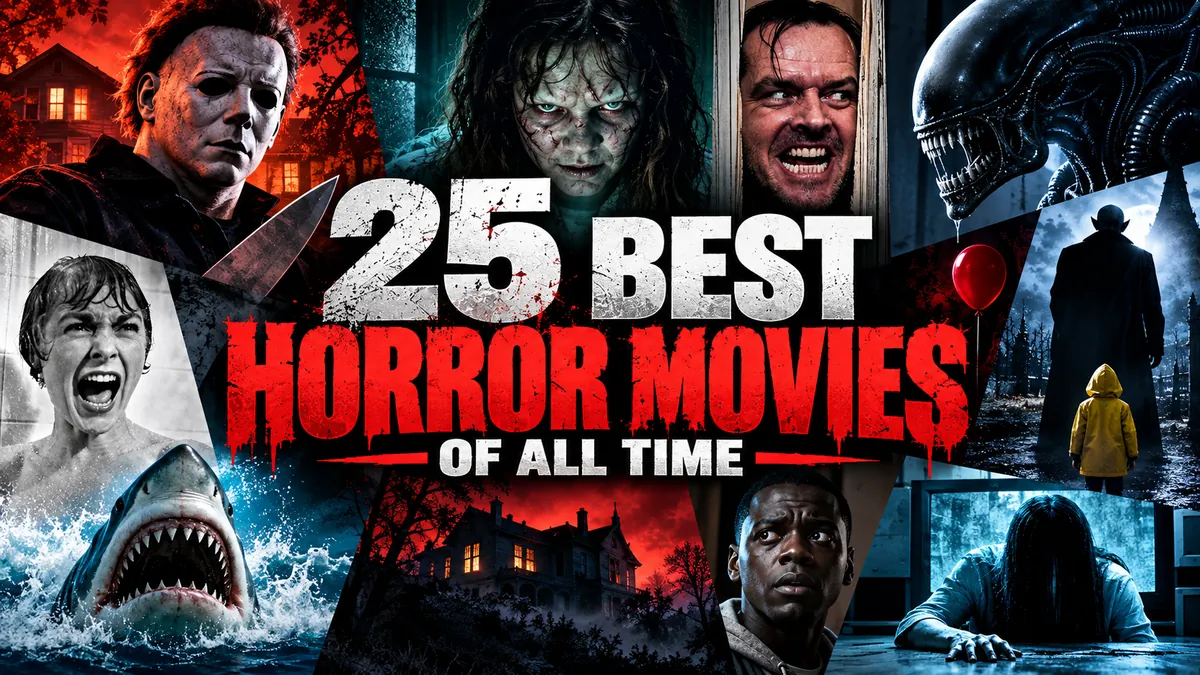
25 Best Horror Movies of All Time, Ranked (2026)
The greatest horror movies do more than make you jump.
They follow you home.
Sometimes the fear comes from a monster hiding in darkness. Sometimes it comes from a person who seems completely ordinary. The most disturbing horror films can make a hotel corridor, suburban street, television screen, dinner party or quiet bedroom feel dangerous long after the credits end.
That is why ranking the best horror movies is more complicated than simply asking which films are the scariest.
For this list, we considered critical reputation, influence on the genre, filmmaking craft, originality, performances, atmosphere, audience impact, rewatchability and how effectively each movie still works for viewers in 2026.
The result stretches from silent-era nightmares to modern psychological horror, supernatural classics, slashers, science-fiction terror and international masterpieces.
Some are frightening.
Some are disturbing.
Some are strangely beautiful.
The best are all three.
Here are the 25 best horror movies of all time.
Best Horror Movies: Quick Ranking
| Rank | Movie | Year | Best For |
|---|---|---|---|
| 1 | The Exorcist | 1973 | Supernatural horror |
| 2 | The Shining | 1980 | Psychological horror |
| 3 | Psycho | 1960 | Suspense and psychological horror |
| 4 | Alien | 1979 | Sci-fi horror |
| 5 | The Thing | 1982 | Paranoia and body horror |
| 6 | The Texas Chain Saw Massacre | 1974 | Raw terror |
| 7 | Halloween | 1978 | Slasher horror |
| 8 | The Silence of the Lambs | 1991 | Psychological horror/thriller |
| 9 | Rosemary’s Baby | 1968 | Occult horror |
| 10 | Night of the Living Dead | 1968 | Zombie horror |
| 11 | Jaws | 1975 | Creature horror |
| 12 | Get Out | 2017 | Social horror |
| 13 | The Wicker Man | 1973 | Folk horror |
| 14 | Hereditary | 2018 | Modern supernatural horror |
| 15 | The Blair Witch Project | 1999 | Found-footage horror |
| 16 | Ringu | 1998 | Japanese supernatural horror |
| 17 | A Nightmare on Elm Street | 1984 | Supernatural slasher |
| 18 | The Fly | 1986 | Body horror |
| 19 | The Witch | 2015 | Historical folk horror |
| 20 | The Babadook | 2014 | Psychological supernatural horror |
| 21 | Scream | 1996 | Meta slasher |
| 22 | The Conjuring | 2013 | Haunted-house horror |
| 23 | Train to Busan | 2016 | Zombie thriller |
| 24 | Nosferatu | 1922 | Silent Gothic horror |
| 25 | The Ring | 2002 | Supernatural mystery |
1. The Exorcist
Best for: Supernatural horror that takes itself completely seriously
William Friedkin’s The Exorcist remains one of the defining horror films because it approaches an impossible situation with almost documentary-like seriousness.
A young girl begins displaying increasingly disturbing behavior. Her mother searches for medical explanations before confronting a possibility that modern medicine cannot easily explain.
The movie does not rush toward supernatural spectacle.
It builds doubt.
That patience makes what follows much more disturbing.
Why it ranks No. 1
Plenty of horror movies are frightening for a few years.
The Exorcist became part of cultural vocabulary.
Its influence can be felt throughout possession movies, religious horror and supernatural cinema.
But influence alone would not earn the top spot.
The movie still works.
Its atmosphere is oppressive, its performances remain convincing and its central conflict explores faith, fear, parenthood and helplessness rather than simply using possession as an excuse for visual shocks.
Is it still scary?
Yes, although not necessarily in the same way for every viewer.
Modern audiences accustomed to faster editing may find its deliberate pacing unusual.
Give it time.
The patience is part of the design.
Watch if you like: Possession stories, religious horror and serious supernatural films.
2. The Shining
Best for: Psychological horror and unforgettable imagery
A writer accepts a winter caretaker position at the isolated Overlook Hotel.
He brings his wife and young son.
Snow closes in.
The hotel empties.
And isolation begins doing terrible things.
Stanley Kubrick’s The Shining does not explain everything it shows you.
That is one reason viewers continue discussing it decades later.
Why it ranks this high
The Overlook Hotel is effectively a character.
Its carpets, corridors, enormous rooms and impossible-feeling geography create constant unease.
Jack Nicholson’s performance is enormous, but Shelley Duvall’s terrified vulnerability and Danny Lloyd’s quiet presence are equally important.
Kubrick’s use of Steadicam movement also helped give the film a visual language that became enormously influential in horror filmmaking.
What kind of horror is it?
Part haunted-house movie.
Part family nightmare.
Part psychological collapse.
The ambiguity between those possibilities makes it endlessly rewatchable.
Watch if you like: Slow-burn dread, haunted locations and movies that invite interpretation.
3. Psycho
Best for: Suspense, psychological horror and film-history fans
Alfred Hitchcock changed horror by bringing terror somewhere ordinary.
A roadside motel.
A nervous young woman.
A polite proprietor.
Nothing needs to emerge from another planet or an ancient tomb.
The danger is already here.
Why it deserves the top three
Psycho shattered expectations about what mainstream Hollywood suspense could show and how stories could be structured.
Bernard Herrmann’s string-heavy score became inseparable from the movie’s most famous sequences.
Anthony Perkins created one of cinema’s most memorable performances as Norman Bates.
Most importantly, the movie remains remarkably effective even when you already know its secrets.
That is the mark of great filmmaking.
A twist works once.
Atmosphere works forever.
Watch if you like: Psychological thrillers, serial-killer stories and suspense.
4. Alien
Best for: Science-fiction horror
In space, there is nowhere to run.
Ridley Scott’s Alien follows the crew of the commercial spacecraft Nostromo after they investigate a mysterious signal.
What they encounter becomes one of cinema’s most recognizable monsters.
But the creature alone is not why Alien works.
Why it ranks so high
The Nostromo feels functional.
Dirty.
Industrial.
Lived-in.
The characters behave more like workers than glamorous space explorers.
That realism makes the intrusion of something completely alien much more disturbing.
H.R. Giger’s biomechanical creature design remains extraordinary, while Sigourney Weaver’s Ellen Ripley became one of science-fiction cinema’s defining protagonists.
Alien or Aliens?
Both are excellent.
James Cameron’s Aliens expands the story into extraordinary action-horror.
But Ridley Scott’s original is the purer horror movie.
Watch if you like: Space, claustrophobia, monsters and survival horror.
5. The Thing
Best for: Paranoia and body horror
Researchers at an isolated Antarctic station discover an organism capable of imitating other living beings.
That means anyone could be infected.
Anyone could be lying.
Anyone might no longer be human.
John Carpenter builds nearly an entire movie around that terrifying uncertainty.
Why it deserves No. 5
Rob Bottin’s practical creature effects remain astonishing precisely because they do not behave like one conventional monster.
The Thing transforms.
Splits.
Mimics.
Reconstructs.
The audience never becomes comfortable with its physical rules.
But the movie’s greatest special effect is paranoia.
Once trust disappears, the freezing Antarctic environment becomes almost secondary.
Watch if you like: Body horror, practical effects, isolation and mystery.
6. The Texas Chain Saw Massacre
Best for: Viewers who want horror to feel dangerous
Tobe Hooper’s 1974 film has a reputation for extreme violence.
What is remarkable is how much of its brutality is created through suggestion, sound, editing and atmosphere rather than nonstop graphic imagery.
A group of young travelers encounter a rural family.
That is enough plot.
The experience is what matters.
Why it remains essential
Few horror movies feel this physically uncomfortable.
Heat seems to radiate from the screen.
The environments look dirty.
The sound design attacks you.
Leatherface became a horror icon, but the movie around him is stranger and more unsettling than many of the slashers it later influenced.
Watch if you like: Raw 1970s horror and relentless tension.
7. Halloween
Best for: The pure slasher experience
John Carpenter’s 1978 Halloween helped define the modern slasher.
Michael Myers returns to Haddonfield and begins stalking teenage babysitters on Halloween night.
That simple premise became one of horror cinema’s most durable formulas.
Why it still works
Carpenter understands empty space.
Michael can be standing far behind a character.
At the edge of the frame.
Across the street.
Near a hedge.
The fear comes from knowing he is there before the character does.
Carpenter’s minimalist score adds extraordinary tension without requiring elaborate orchestration.
Jamie Lee Curtis also established Laurie Strode as one of horror’s defining final girls.
Watch if you like: Slashers, stalking sequences and minimalist suspense.
8. The Silence of the Lambs
Best for: Psychological horror and crime-thriller fans
FBI trainee Clarice Starling seeks insight from imprisoned psychiatrist and murderer Hannibal Lecter while investigators hunt another killer.
The conversations between Clarice and Lecter become psychological contests.
Anthony Hopkins does not need enormous screen time to dominate the film.
Jodie Foster’s performance prevents him from dominating Clarice.
Why it belongs on a horror list
Some viewers classify The Silence of the Lambs primarily as a thriller.
Genre boundaries are flexible.
Its serial-killer imagery, psychological terror, confinement and climactic suspense place it comfortably within horror’s wider territory.
Its awards success also demonstrated that horror-adjacent filmmaking could achieve the highest level of mainstream critical recognition.
Watch if you like: Crime, serial killers and psychological tension.
9. Rosemary’s Baby
Best for: Slow-burning occult horror
Rosemary and her husband move into a New York apartment building.
Their neighbors are unusually interested in them.
That interest becomes increasingly uncomfortable.
Roman Polanski’s film understands that paranoia becomes frightening when everyone around you insists nothing is wrong.
Why it remains powerful
The movie builds horror through social pressure.
Politeness becomes threatening.
Friendly neighbors become invasive.
Domestic spaces stop feeling private.
Mia Farrow’s performance keeps the story emotionally grounded as Rosemary’s confidence in the people around her begins to collapse.
Watch if you like: Conspiracies, occult horror and slow-building paranoia.
10. Night of the Living Dead
Best for: Understanding where modern zombie cinema began
George A. Romero did not invent stories about the dead returning.
He did something more important for modern horror.
He established much of the cinematic language audiences now associate with zombie apocalypse stories.
A group of strangers barricade themselves inside a farmhouse while the dead gather outside.
Why it remains essential
The external threat is frightening.
The people trapped inside may be worse at cooperating than the monsters are at attacking.
That dynamic became fundamental to later zombie stories.
The film’s stark black-and-white photography also gives it a news-footage immediacy that still feels unsettling.
Watch if you like: Zombies, siege movies and apocalyptic horror.
11. Jaws
Best for: Viewers who think they do not like horror
Steven Spielberg’s Jaws turned a shark into a cultural nightmare.
A great white begins attacking people around the beach community of Amity Island.
The local police chief wants the beaches closed.
Economic and political pressures complicate that obvious solution.
Then the movie eventually moves out to sea.
Why it belongs among the best horror movies
The shark is frightening.
Anticipation is worse.
John Williams’ famous score teaches the audience to fear something that may not even be visible.
Spielberg also spends enough time establishing the community that the threat matters beyond individual attack sequences.
Watch if you like: Creature features, adventure and suspense.
12. Get Out
Best for: Smart modern horror with social commentary
Chris travels with his girlfriend Rose to meet her family.
Everyone is welcoming.
Perhaps too welcoming.
Jordan Peele gradually turns awkward social interactions into something much more sinister.
Why it became an instant modern classic
Get Out works simultaneously as horror, satire, mystery and dark comedy.
The social observations are not separate from the scares.
They create them.
Daniel Kaluuya’s controlled performance is essential because much of the tension depends on Chris noticing things that other people attempt to dismiss.
The film also proved that socially conscious horror could be both commercially accessible and critically celebrated.
Watch if you like: Mystery, satire and horror that gives you something to discuss afterward.
13. The Wicker Man
Best for: Folk horror
A police officer travels to a remote Scottish island to investigate a missing girl.
The residents insist nothing unusual has happened.
Their traditions suggest otherwise.
Robin Hardy’s 1973 film gradually transforms cultural misunderstanding into profound unease.
Why it matters
The Wicker Man helped establish the vocabulary now associated with folk horror:
isolated communities;
ancient rituals;
beautiful landscapes;
religious conflict;
and traditions outsiders do not understand.
Christopher Lee gives one of his most memorable performances.
Watch if you like: Midsommar, cults, folklore and rural horror.
14. Hereditary
Best for: Modern viewers who want emotionally brutal horror
A family begins unraveling after the death of its secretive grandmother.
Saying much more would diminish the experience.
Ari Aster’s Hereditary works because grief arrives before the full horror does.
Why it ranks among modern classics
Toni Collette gives an extraordinary performance as a mother trying to process grief while her family fractures around her.
Aster frequently frames rooms like miniature displays, making characters appear trapped inside spaces they supposedly control.
The supernatural elements become increasingly important, but the emotional damage makes them frightening.
Watch if you like: Family trauma, occult horror and slow-burn dread.
15. The Blair Witch Project
Best for: Found-footage horror
Three student filmmakers enter the woods to investigate a local legend.
They disappear.
The footage is supposedly what remains.
That simple framing device changed low-budget horror.
Why it matters
The Blair Witch Project demonstrated that suggestion could be more powerful than expensive effects.
The woods become frightening because characters cannot establish where they are.
Small sounds become terrifying because the camera cannot show their source.
Its marketing also blurred fiction and reality in ways that became especially effective during the early internet era.
Is it still scary?
It depends heavily on how you watch it.
Lights off.
Phone away.
Headphones or good speakers.
Let the emptiness work.
Watch if you like: Found footage and minimalist horror.
16. Ringu
Best for: Japanese supernatural horror
A journalist investigates a mysterious videotape connected to a series of deaths.
Anyone who watches it apparently has seven days left.
Hideo Nakata’s 1998 Japanese film transformed an ordinary television into an object of dread.
Why it deserves its place
Ringu became one of the central films in the international wave of Japanese horror that influenced global genre cinema around the turn of the millennium.
Its supernatural threat is memorable.
Its atmosphere is even better.
Rather than relying on constant shocks, the film creates a sense that something inevitable is approaching.
Watch if you like: Ghost stories, curses and atmospheric horror.
17. A Nightmare on Elm Street
Best for: Imaginative supernatural slashers
Most slasher villains have one limitation.
Eventually you can go home and lock the door.
Freddy Krueger attacks you while you sleep.
Wes Craven turned that idea into one of horror’s most inventive franchises.
Why the original remains essential
Dreams remove ordinary physical rules.
Walls, rooms, gravity and bodies can behave unpredictably.
That gave Craven creative freedom far beyond the standard masked-killer formula.
Robert Englund’s Freddy would become increasingly comedic in later installments, but the original movie keeps him frightening.
Watch if you like: Slashers with supernatural imagination.
18. The Fly
Best for: Body horror with genuine emotion
Scientist Seth Brundle develops teleportation technology.
An experiment goes wrong.
Very wrong.
David Cronenberg uses that science-fiction premise to explore physical transformation, disease, intimacy and loss.
Why it works
The effects are disturbing because the emotional relationship underneath them is believable.
Jeff Goldblum and Geena Davis make the tragedy matter.
The horror is not simply that Brundle’s body changes.
It is that he remains aware of what he is losing.
Watch if you like: Body horror, science fiction and tragic character stories.
19. The Witch
Best for: Historical folk horror
A Puritan family is expelled from its community and establishes a farm near a forest.
Their isolation quickly becomes dangerous.
Robert Eggers’ feature debut uses period detail, religious fear and old folklore to build an atmosphere that feels removed from modern life.
Why it stands out
The characters genuinely believe in damnation.
That matters.
Their worldview is not decorative background.
It shapes every decision they make.
Anya Taylor-Joy’s breakthrough performance gives the story an increasingly compelling center.
Watch if you like: Historical settings, folklore and slow horror.
20. The Babadook
Best for: Psychological horror about grief
A widowed mother struggles to raise her young son.
Then a disturbing children’s book appears in their home.
Its central figure—the Babadook—becomes increasingly difficult to dismiss.
Why it works
Jennifer Kent uses supernatural horror to explore emotional states without reducing the monster to a simple metaphor.
The film understands exhaustion.
Isolation.
Anger.
Grief.
Parenthood.
Those recognizable emotions make the supernatural intrusion more powerful.
Watch if you like: Character-driven horror and unsettling supernatural stories.
21. Scream
Best for: Horror fans who already know the rules
A masked killer begins targeting teenagers in Woodsboro.
The victims have one unusual advantage.
They have watched horror movies.
Wes Craven and screenwriter Kevin Williamson turned genre awareness into a weapon.
Why it revitalized the slasher
Scream makes jokes about horror conventions while still functioning as an effective horror movie.
That balance is difficult.
Too much comedy and the fear disappears.
Too much seriousness and the self-awareness becomes pointless.
The original finds the balance.
Ghostface subsequently became one of horror cinema’s most recognizable masks.
Watch if you like: Slashers, mysteries and dark comedy.
22. The Conjuring
Best for: Traditional haunted-house scares
Paranormal investigators Ed and Lorraine Warren help a family experiencing disturbing events in their Rhode Island farmhouse.
James Wan does not reinvent haunted-house cinema.
He demonstrates how effective its traditional tools can still be.
Why it deserves the list
Doors.
Dark rooms.
Strange noises.
Basements.
Something standing where nothing should be standing.
Wan builds sequences around anticipation rather than simply throwing digital creatures at the screen.
Patrick Wilson and Vera Farmiga also give the movie a warm emotional center.
Its success eventually launched a much larger horror universe.
Watch if you like: Ghosts, haunted houses and accessible supernatural horror.
23. Train to Busan
Best for: Fast zombie horror with emotional stakes
A father and daughter board a train from Seoul to Busan.
A zombie outbreak begins spreading.
The train becomes a moving survival environment.
Yeon Sang-ho’s film combines relentless momentum with characters worth caring about.
Why it stands out
Zombie movies often become repetitive once the outbreak begins.
Train to Busan keeps changing the physical problem.
Different carriages create different obstacles.
Stations create new threats.
Passengers make decisions that can be as dangerous as the infected.
The emotional payoff is also unusually strong for such a fast-moving genre movie.
Watch if you like: Zombies, action and Korean cinema.
24. Nosferatu
Best for: Exploring horror cinema’s foundations
F.W. Murnau’s 1922 silent film remains one of the foundational works of screen horror.
It is an unauthorized adaptation of Bram Stoker’s Dracula, with Count Dracula transformed into Count Orlok.
Max Schreck’s Orlok looks less like an elegant aristocrat and more like something that should never have entered a human home.
Why a silent movie still belongs here
Look at the shadow imagery.
The elongated fingers.
The empty landscapes.
The plague associations.
Modern vampire cinema inherited more from this film than many viewers realize.
Its survival is itself remarkable: legal action over the unauthorized Dracula adaptation resulted in an order that copies be destroyed, yet prints survived.
More than a century later, Orlok’s silhouette remains recognizable.
Watch if you like: Film history, vampires and Gothic horror.
25. The Ring
Best for: Mainstream supernatural mystery
A journalist investigates a videotape connected to a terrifying urban legend.
Watch it.
Then the phone rings.
Seven days.
Gore Verbinski’s 2002 film adapts Hideo Nakata’s Japanese Ringu for American audiences while creating its own cold, rain-soaked visual identity.
Why it makes the list
Hollywood horror remakes are inconsistent.
The Ring is one of the exceptions.
Naomi Watts gives the mystery a convincing human center, while the cursed-video concept became one of the defining horror images of the early 2000s.
The original Japanese film ranks higher because of its historical influence and stripped-down atmosphere.
The American version remains one of the strongest supernatural studio horror films of its era.
Watch if you like: Curses, investigations and supernatural mysteries.
Best Horror Movies by Genre
Not every horror fan wants the same kind of fear.
Best Psychological Horror Movies
Start with:
The Shining
Psycho
The Silence of the Lambs
The Babadook
These movies create fear primarily through people, uncertainty and psychological pressure.
Best Supernatural Horror Movies
Our top picks are:
The Exorcist
Hereditary
Ringu
The Conjuring
Choose The Exorcist for possession, Hereditary for modern occult horror and The Conjuring for a more traditional haunted-house experience.
Best Slasher Movies
Start with:
Halloween
A Nightmare on Elm Street
Scream
Halloween is the essential minimalist slasher.
Elm Street adds supernatural imagination.
Scream deconstructs the genre while still participating in it.
Best Sci-Fi Horror Movies
Alien and The Thing are the essentials.
Alien emphasizes claustrophobic survival.
The Thing emphasizes paranoia and body horror.
Best Zombie Movies
Night of the Living Dead is historically essential.
Train to Busan is our recommendation for viewers wanting a faster modern experience.
Best Folk Horror Movies
Start with The Wicker Man.
Then watch The Witch.
The two films were released more than four decades apart but demonstrate how effectively landscape, isolation and belief systems can generate horror.
Best Horror Movies for Beginners
If you are new to horror, jumping directly into the most disturbing movie possible is not necessarily the best approach.
Try these first:
Jaws
A perfect bridge between adventure, thriller and horror.
The Conjuring
Accessible supernatural horror with strong mainstream pacing.
Scream
Especially enjoyable if you already understand basic slasher conventions.
Get Out
Funny, tense and easy to discuss afterward.
Alien
A great choice for science-fiction fans entering horror.
Train to Busan
Excellent for viewers who want fast pacing and emotional storytelling.
After those, move toward heavier films such as Hereditary, The Exorcist and The Texas Chain Saw Massacre.
Scariest Horror Movies on This List
“Scariest” is completely subjective.
Different fears work on different people.
But if your main objective is being frightened, start with:
The Exorcist — possession and religious horror
The Shining — isolation and psychological dread
The Texas Chain Saw Massacre — relentless panic
Hereditary — family trauma and occult horror
Ringu — supernatural dread
The Conjuring — traditional jump scares and haunted-house tension
The Blair Witch Project — fear of unseen threats
The Thing — paranoia and body horror
Watching conditions matter too.
A horror movie on a bright afternoon while checking social media every five minutes is a very different experience from watching alone at night with the lights off.
Best Horror Movies for Halloween
For Halloween night, atmosphere matters almost as much as quality.
Our strongest picks are:
Halloween — obviously.
Scream — ideal for a group.
The Conjuring — traditional haunted-house entertainment.
A Nightmare on Elm Street — imaginative and iconic.
The Exorcist — for a more serious night.
The Shining — perfect for slow-burning dread.
For a classic double feature, pair Halloween with Scream.
For supernatural horror, pair The Exorcist with The Conjuring.
Best Modern Horror Movies
If you want something from the 21st century rather than the established classics, start with:
- Hereditary
- Get Out
- Train to Busan
- The Witch
- The Babadook
- The Conjuring
These films demonstrate how varied modern horror has become.
One uses social satire.
Another historical folklore.
Another family grief.
Another a zombie outbreak.
Modern horror is not one movement or one style.
That variety is one reason the genre remains creatively healthy.
Classic Horror vs Modern Horror
Classic horror frequently had to suggest more because filmmakers faced stricter censorship, technical limitations or both.
That limitation encouraged extraordinary use of:
shadows;
sound;
editing;
off-screen space;
practical effects;
and audience imagination.
Modern filmmakers have fewer technical restrictions.
That creates different possibilities.
A movie like Hereditary can combine precise digital manipulation with old-fashioned framing.
Train to Busan can stage enormous zombie sequences while retaining intimate character drama.
Get Out can move fluidly between satire, mystery and horror.
Neither era is inherently better.
The best modern horror filmmakers understand what older movies knew:
Seeing everything is rarely as frightening as imagining it.
What Makes a Great Horror Movie?
Atmosphere
Fear begins before anything frightening happens.
A great horror movie makes ordinary spaces feel unsafe.
Characters
If viewers do not care what happens to anyone, danger loses much of its power.
Restraint
Showing the monster constantly can make it less frightening.
Mystery gives audiences space to imagine something worse.
Sound
Horror may depend on sound more than almost any other genre.
Music can create anticipation.
Silence can be even more frightening.
Originality
The genre survives by reinventing familiar fears.
Psycho changed where horror could happen.
Night of the Living Dead reshaped zombies.
Halloween refined the slasher.
The Blair Witch Project transformed found footage.
Get Out brought a distinct social perspective to mainstream horror.
The strongest horror movies do not merely scare audiences.
They give later filmmakers new ways to scare them.
Horror Movies That Changed the Genre
Several films on this list are particularly important historically.
Nosferatu
Helped establish the visual language of cinematic vampires and Gothic horror.
Psycho
Brought psychological terror into familiar modern spaces and profoundly influenced later slasher cinema.
Night of the Living Dead
Established the template for modern zombie apocalypse storytelling.
The Texas Chain Saw Massacre
Pushed low-budget American horror toward a rawer, more confrontational style.
Halloween
Helped establish the commercial and stylistic template for the modern slasher boom.
Alien
Demonstrated how completely science fiction and horror could merge.
The Blair Witch Project
Showed how low-budget found footage and internet-era marketing could create a cultural phenomenon.
Get Out
Demonstrated the enormous mainstream potential of horror built around social observation and satire.
Frequently Asked Questions
What is the best horror movie of all time?
Our No. 1 choice is The Exorcist (1973).
Its combination of supernatural horror, serious dramatic filmmaking, cultural influence and enduring ability to disturb audiences gives it the top position.
The Shining, Psycho, Alien and The Thing complete our top five.
What are the top 10 horror movies of all time?
Our top 10 are:
- The Exorcist
- The Shining
- Psycho
- Alien
- The Thing
- The Texas Chain Saw Massacre
- Halloween
- The Silence of the Lambs
- Rosemary’s Baby
- Night of the Living Dead
What is the scariest horror movie ever made?
There is no objective answer because fear is personal.
The Exorcist, Hereditary, The Texas Chain Saw Massacre, Ringu, The Shining and The Blair Witch Project are excellent starting points if being frightened is your priority.
What is the best horror movie for beginners?
Jaws is an excellent first horror film because it combines adventure, character drama and suspense.
The Conjuring, Scream, Get Out and Alien are also accessible entry points.
What is the best supernatural horror movie?
The Exorcist is our top supernatural horror movie.
For a modern alternative, watch Hereditary.
For traditional haunted-house scares, choose The Conjuring.
What is the best slasher movie?
John Carpenter’s Halloween (1978) remains our essential slasher recommendation.
Its influence, simplicity, atmosphere and Michael Myers’ iconic presence make it the genre benchmark.
What is the best zombie movie?
George A. Romero’s Night of the Living Dead is the most historically important choice on this list.
For modern audiences seeking faster action, Train to Busan is an excellent alternative.
What is the best horror movie on Netflix?
Streaming availability changes frequently and differs between the US, UK, Canada, Australia and other countries.
Instead of assuming a film remains on Netflix, check the current Netflix catalog in your region before watching.
What are the best horror movies to watch on Halloween?
Start with Halloween, Scream, The Conjuring, A Nightmare on Elm Street, The Exorcist and The Shining.
For groups, Scream is especially entertaining because its humor gives viewers room between scares.
Is Alien a horror movie?
Yes.
Although Alien is also science fiction, its structure uses classic horror techniques: isolation, stalking, body horror, an unknown predator and characters trapped in an environment from which escape is extremely difficult.
Is The Silence of the Lambs a horror movie?
It is commonly described as a psychological thriller, crime film and horror film depending on the classification being used.
Its serial-killer subject matter, psychological terror and horror imagery justify including it in a broad ranking of horror cinema.
Should I watch Ringu or The Ring first?
Watch Ringu (1998) first if you want to experience the influential Japanese original.
Then watch The Ring (2002) to see how Gore Verbinski reinterpreted the material for American studio horror.
Both appear on this list, but Ringu ranks higher.
Which version of The Thing is on this list?
John Carpenter’s 1982 film starring Kurt Russell.
It was preceded by The Thing from Another World in 1951 and followed by a 2011 prequel also titled The Thing, so the year is important when searching for it.
Which Halloween movie should I watch?
Start with John Carpenter’s original Halloween from 1978.
It introduces Michael Myers and Laurie Strode and remains the essential film in the franchise.
Final Thoughts
The best horror movies of all time reveal something important about fear:
It changes.
In 1922, Nosferatu turned a vampire’s shadow into a nightmare.
In 1960, Psycho made audiences afraid of an ordinary motel.
Night of the Living Dead imagined society collapsing outside a farmhouse.
The Exorcist brought supernatural evil into a child’s bedroom.
Alien carried horror into space.
Halloween found terror on a quiet suburban street.
Ringu put a curse inside modern media.
The Blair Witch Project made audiences fear what the camera could not see.
Get Out transformed uncomfortable social interactions into horror.
And Hereditary demonstrated that one of the most frightening places imaginable can still be inside a family home.
That ability to evolve is why horror survives.
The monsters change.
The technology changes.
The filmmaking changes.
But the basic experience remains wonderfully simple.
The lights go down.
Something feels wrong.
And we keep watching.


